
Static Hosting Costs and Trade-offs
Static hosting costs compared with cloud servers, with realistic monthly figures for containers, databases and caching, plus the honest trade-offs to weigh before you move your site.

Most small business sites run on a server that never sleeps, a database that holds nothing a brochure needs, and a monitoring stack nobody looks at. Moving to a static host turns that monthly bill into a monthly coffee, because there is no server running while nobody is looking. The figures below are a planning model you can compare against your own invoice, and the trade-offs are named honestly at the end.
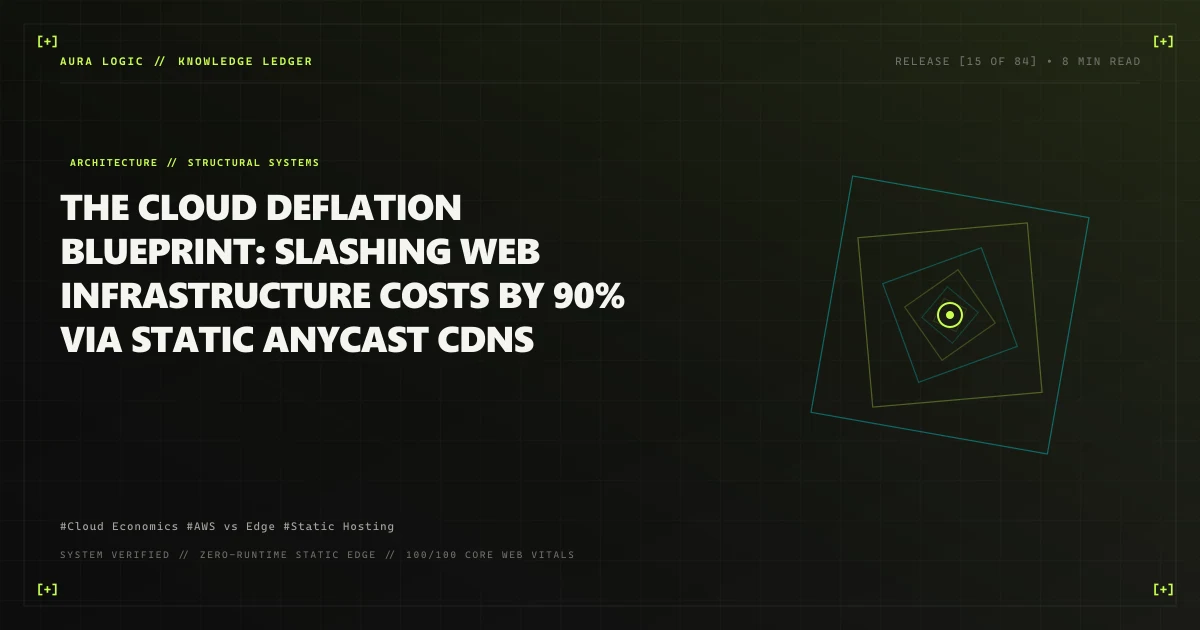
The Cloud Infrastructure Trap
Most businesses that ask us to rebuild their site are running it on infrastructure built for a much larger and more complicated company than they are. A very common setup, inherited from a site that once needed to be an application, is:
- Containerized Node.js/SSR runtimes on AWS ECS or Kubernetes (EKS).
- High-availability relational databases on AWS RDS Multi-AZ.
- In-memory caching layers on AWS ElastiCache (Redis).
- Application Load Balancers (ALB) and CloudWatch monitoring clusters.
For a software application with complex, authenticated multi-user databases — a core banking platform, a claims database, a CRM with per-customer record sets — that architecture is justified. The database is doing real work, and it needs a real server.
None of that applies to your site. A marketing site, a small catalogue or an online store has no per-user session to serve and no live database to query. If you are reading this thinking of a banking or insurance platform you run, stop: the advice below is for the other case, and it does not apply to you. But if your site is a brochure, a catalogue or a shop — which is what this article is about — then what you are running is a brochure with a database attached, and you are paying for that database every month whether or not anybody visits.
┌─────────────────────────────────────────────────────────────────────────────┐
│             THE MONTHLY BILL, IN PLAIN NUMBERS (OUR OWN MODEL)              │
├─────────────────────────────────────────────────────────────────────────────┤
│  WHAT YOU ARE PAYING FOR TODAY (a site with 20,000 visits a month)          │
│  ---------------------------------------------------------------            │
│  A container that runs your site 24 hours a day    $240/mo                  │
│  A database that stores your content               $480/mo                  │
│  A cache that keeps the site quick                 $160/mo                  │
│  A load balancer and the traffic out of it          $220/mo                 │
│  Logs, monitoring and error tracking               $350/mo                  │
│  ---------------------------------------------------------------            │
│  THE BILL YOU PAY                                    TOTAL $1,450/mo        │
│  ---------------------------------------------------------------            │
│  THE SAME SITE, COMPILED TO STATIC FILES            $15/mo                  │
│  ---------------------------------------------------------------            │
│  THE DIFFERENCE                                     $1,435/mo               │
│                                                    $17,220/yr               │
└─────────────────────────────────────────────────────────────────────────────┘
These are the figures we use in our own planning model for the resources named, not prices quoted by AWS and not a quote for your setup, and your own invoice will differ. The point is the shape of the bill: almost all of it is a fixed monthly cost, and none of it scales down when you have a quiet month. The way to check the argument against your own business is to pull your last twelve invoices and find the line items that did not change month to month.
The Mechanics of Anycast Edge Architecture
To understand why static hosting is so much cheaper, it helps to understand Anycast BGP Routing.
In a traditional cloud hosting model, your origin server sits in a single physical data center (for example us-east-1 in Virginia). When a prospective buyer visits from Tokyo, London, or Mexico City, their packets have to cross the ocean to reach your server, wait for a PHP or Node.js runtime to query a database, and travel back. That round trip is dead time you cannot optimise away once the origin is fixed in one place, and compute costs scale with request volume.
Traditional Unicast Origin Architecture:
User in Mexico City ──(one ocean crossing)──> AWS us-east-1 Origin Server ──> MySQL Query ──> Return HTML
Latency: the full crossing, each way | Single Point of Failure | High Cloud Bill

Aura Logic Static Anycast Edge:
User in Mexico City ──(a local edge node)──> Mexico City Edge Data Center (Direct Memory Cache) ──> Instant HTML Paint
Latency: within 50ms for 95% of users | 330+ Edge Cities | Sub-$20/mo in our model
The latency line on the edge side is not ours: Cloudflare states that 95% of the world’s internet-connected population is within 50 milliseconds of one of its data centers, and that most are within 20 milliseconds. The cost line is our own model.
In an Astro static edge deployment:
- Pre-Compilation: At build time, your whole website, its MDX articles, and its design tokens are compiled into immutable, optimized HTML, CSS, and AVIF assets.
- Global Edge Distribution: The compiled bundle is replicated across 330+ edge cities worldwide — Cloudflare’s network page currently lists 348 cities (Cloudflare Pages, Fastly, AWS CloudFront).
- Near-Instant Resolution: When someone types your domain, Anycast BGP routes their request to the closest edge server, which serves the pre-rendered HTML straight from local memory without touching an origin. Cloudflare describes the mechanism in its own documentation: Anycast routing uses Anycast IP addressing to route traffic to the nearest data center.
Surviving a Traffic Spike
One of the riskiest moments for a small business is a high-visibility moment: a radio mention, a product launch on Product Hunt, a post that gets shared, or a press release. The traffic arrives in seconds, and the site has to stay up, because the moment you have spent the most on is the moment it falls over.
In a containerized dynamic environment:
- Thousands of concurrent visitors hit the origin server within seconds.
- Node.js event loops saturate, and database connection pools exhaust.
- Auto-scaling groups attempt to provision new containers, but that takes minutes rather than seconds.
- Visitors are greeted with 504 Gateway Timeout or 502 Bad Gateway error screens, which is the worst possible moment for the campaign that caused the traffic.
This is the specific failure that ends a launch. The product is good, the post is shared, and the site is down for the only hour that mattered.
In a static edge architecture:
- Static assets are cached at the edge, so repeat requests are answered without going back to the origin.
- Whether your site receives ten visitors or a million in a burst, the requests are answered at the edge rather than at your origin.
- Edge networks absorb the traffic without configuration changes, autoscaling delay, or additional hosting fees.
Eliminating the Hidden DevOps Retainer
The savings go past the invoice. In a dynamic cloud setup, somebody has to:
- Manage Kubernetes Helm charts and Docker containers.
- Monitor database read-replica lag and connection pooling.
- Perform emergency midnight rollbacks when server memory leaks trigger OOM (Out of Memory) kills.
- Maintain staging and production environment parity.
That is a full-time job. If you built your site around a big cloud backend, somebody on your side is doing this work — or paying a contractor to do it — and paying for it in every invoice since.
With Aura Logic’s Astro Content Collection workflow:
- No Servers to Manage: There is no operating system to patch, no Linux daemon to monitor, and no database socket to maintain.
- Git-Driven CI/CD: Content and code are committed to Git. In our own pipeline, automated build steps validate schemas, compile the static bundle, and deploy globally in under 90 seconds — that is the figure from our own workflow, not a published standard.
- Instant Atomic Rollbacks: Every Git commit is an immutable snapshot. If an error ships, rolling back to the previous version is a single command and takes seconds.
Conclusion: Architectural Simplicity as a Strategic Asset
The highest form of engineering sophistication is not adding complexity; it is eliminating it. By replacing a dynamic cloud server with static edge delivery, a small business removes cloud debt, gets sub-second page loads worldwide as the normal case rather than the best case, and lowers its fixed cost structure permanently.
The trade-offs are real, and it is fair to name them. Static hosting suits content that changes when you publish it, and it does not suit an application that has to run logic per request: a logged-in dashboard, a booking engine with live availability, a cart that prices against a live database. Those parts usually need a small server alongside the static site, and the honest answer for a hybrid product is a hybrid architecture.
Ready to cut your hosting bill and stop maintaining a server? Estimate your project scope with our Calculator or review our Case Studies.
Frequently Addressed Technical Inquiries
Why is dynamic cloud hosting so expensive compared to static edge distribution? [+]
Dynamic hosting requires running continuous virtual machines or containers (AWS EC2, ECS, or Kubernetes) alongside high-availability relational databases (RDS Multi-AZ) and in-memory caches (Redis). These resources consume compute hours 24/7 regardless of traffic, whereas static edge delivery costs pennies per gigabyte served purely on demand.
How do static Anycast CDNs handle sudden viral traffic spikes? [+]
Anycast routing distributes incoming traffic across many global edge locations simultaneously. Because pages are pre-compiled flat files stored in edge memory caches, a sudden surge is absorbed by the edge rather than by your origin server, and the origin does not have to scale up or restart.
What are the DevOps and operational savings of eliminating web servers? [+]
Eliminating web servers removes the need for container orchestration, Kubernetes manifests, OS security patching, load balancer tuning, and on-call DevOps alerts for web downtime. Content deployment becomes a simple Git-driven CI/CD build pipeline that completes in under 90 seconds.
Sources
- [1] Cloudflare Global Network | Data Center Locations Verifies the edge figures used in this article: the network page currently lists 348 cities in more than 100 countries, and states that 95% of the world's internet-connected population is within 50 milliseconds of a Cloudflare data center, with most within 20 milliseconds.
- [2] Traffic flow through Cloudflare | Cloudflare Fundamentals Verifies the routing mechanism described in the architecture section: Anycast routing uses Anycast IP addressing to route traffic to the nearest Cloudflare data center, so requests are handled by a server as close to the source as possible.
Related articles
Replacing A Slow Website Platform Without Losing Your Rankings
Your current site is slow, expensive to change and hard to leave. A phased migration moves it to fast static hosting without breaking your links.

Web Standards and Long-Term Maintenance
Building on web standards instead of frameworks, and why Custom Elements, CSS custom properties and plain HTML mean a small business site does not need rewriting every two years.
Why Your Website Probably Doesn't Need Next.js
Next.js costs more to run and slower to load for a small business site, so here is how the bills add up and what to ask your developer instead.
WANT IT REVIEWED FOR YOUR BUSINESS?
The above is general. Tell me about your business and I will review business websites for your case: what applies, what does not, and in what order.
Business websites ↗TELL US ABOUT
YOUR BUSINESS.
Tell us what your business does, what you need and your approximate budget. We will review the scope and next steps with you.
READY TO IMPROVE YOUR WEBSITE?
Describe what you want your website to do for your business. Jorge will help you define the scope, understand the cost and choose the next step.